Horses
News of the WorldThe horses accompanying Jefferson Kyle Kidd and Johanna are the journey’s working partners, not interchangeable scenery: they pull the wagon, negotiate dangerous water, require rest and shoeing, and continue to matter when their human companions are exhausted or under attack. The contrast between the animals’ physical needs and the urgency of the travelers’ mission gives the journey a practical rhythm, while their distinct temperaments and bodies make that rhythm personal.
The Traveling Team
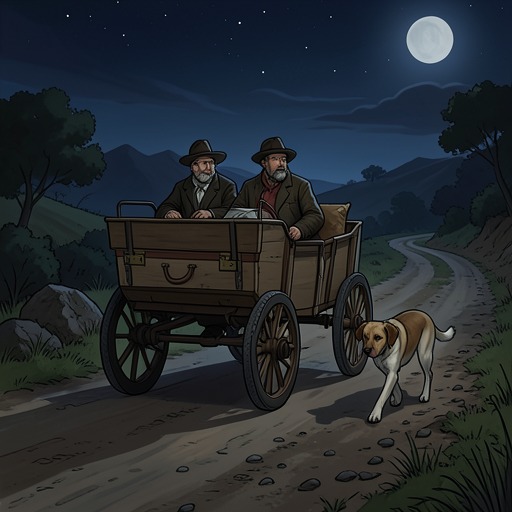
When Jefferson Kyle Kidd buys the dark-green Curative Waters wagon, its spring seat promises relief from ruts and hammering, but the vehicle also changes how he can travel with Johanna. His roan mare, Fancy, can pull it; his bay saddle horse follows behind. Keeping Johanna within sight is another reason for choosing a wagon, so the horses’ arrangement serves both the journey and the Captain’s effort to keep his young passenger close.
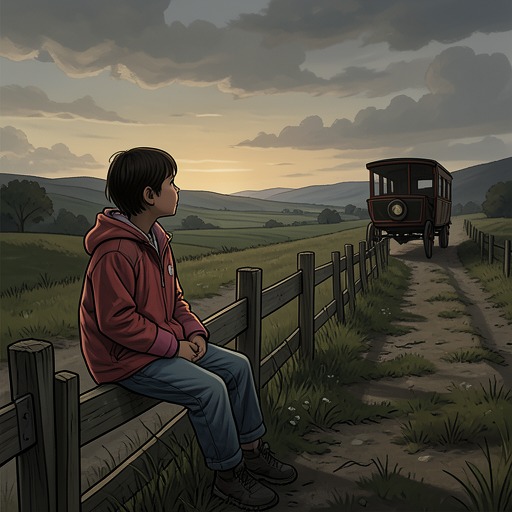
The team has its own resistance to the work. As the travelers depart through red mud, the big bay horses pulling Britt Johnson’s freight wagons lean into their collars, while Fancy initially sulks, dances in the harness, and refuses to pull. Jefferson addresses her by name and reminds her of the food and shoes he provides before urging her onward. The moment makes the team’s movement more than a piece of logistics: departure depends on the mare accepting the harness, and the old traveler must coax rather than simply command.
The animals also carry histories of injury and labor in their bodies. Johanna notices at once that Fancy’s right foreleg is slightly twisted and that her hoof turns inward; Jefferson had bought her cheaply because of the defect. Rather than treating the mare’s condition as invisible, Johanna gently runs her hand down the leg and makes a pitying sound. Her attention to the animal offers an early point of contact between girl and horse, founded on noticing vulnerability rather than on speech.
Water, Work, and Risk
The horses’ labor becomes most perilous at the flooded upper Little Wichita, near its meeting with the Red River. Jefferson lifts Johanna into the wagon, releases Pasha’s lead rope, and prepares a butcher knife in case he must cut Fancy free of her harness. They approach at a fast trot and enter at a gallop, but the current stops them and then takes hold of the mare and wagon. The wagon briefly floats; Fancy goes under, resurfaces, and beats at the water with her hooves before finding firm ground and pulling them onto the far bank.
Pasha does not remain behind. Described as constitutionally brave, he plunges into the flood after them, emerges downstream, shakes water from himself, and trots back to rejoin the wagon. Jefferson ties him again, and the party continues despite a newly discovered break in the wagon’s front-wheel tire. The crossing thus turns the animals’ physical courage and effort into the means of the group’s survival, while leaving the travelers with damaged equipment and further uncertainty about the road ahead.
The danger of the flood is not isolated from the wider movement of people and animals across the landscape. During a later storm by the swollen Red River, Johanna sees a Kiowa party across the water, displaced by the rising flood. She calls to them, but the river is too loud and too wide for them to hear. The scene places horses within a moving community that includes armed adults, children on travois, and tipi poles carried on horses. The animals are part of that community’s ability to travel, even as the flood makes reunion impossible in the moment.
Care After the Gunfight
After the travelers survive a fight near the Brazos River, Jefferson wakes to a clean camp beneath pecan trees and Johanna urging him to eat. The horses are grazing nearby, their bell audible. The quiet is not a return to effortless safety: Jefferson’s eyebrow is cut, and he recognizes that recovery takes longer at his age. He also recognizes that the horses need rest and care as much as he does. Their survival requires attention to more than the immediate threat of violence.
He checks Fancy and Pasha’s legs for swelling and finds them all right, but notes that they were last shod in Bowie and will soon need new shoes. His effort to teach Johanna to look after them is set against the narration’s broad statement that Plains Indians rode their horses hard and, as a last resort, ate them. Whatever the generalization’s limits, the immediate scene makes care a concrete journeying skill: their animals have worked through mud, rain, and flood, and continued travel depends on attending to their condition.
The morning also reveals how animal routines help restore ordinary life after violence. Johanna plays in the stream while the horses graze; the mare’s bell sounds near the breakfast camp, and Jefferson drinks coffee and tries to quiet his thoughts. Food, grazing, and the inspection of legs and hooves do not erase the fight, but they give the exhausted travelers a practical sequence of tasks before they set out again.
Distinct Presence and Narrative Meaning
The horses are differentiated by their actions rather than by lengthy histories. Fancy is the young, strong mare with the turned-in hoof, reluctant at the harness but capable of pulling the wagon through a dangerous crossing. Pasha is the horse who follows into the flood without hesitation and returns to the party. Their contrasting behavior gives the journey a small but persistent drama: a horse may resist, endure, plunge forward, or need tending, and each response affects the people depending on it.
The novel’s attention to these animals also complicates the idea that travel is simply a matter of human resolve. Jefferson may have a destination and Johanna may have ties across the river, but a broken tire, an injured leg, the need for new shoes, or a current strong enough to seize a wagon can alter what the travelers can attempt. Horses make distance possible while exposing its cost. Their labor binds human plans to living bodies that must be fed, rested, and protected; in that sense, they are among the journey’s quiet measures of endurance.